
Camden Lawyers
Camden solicitors you can trust
Our specialist lawyers have a strong record of giving expert legal advice and achieving success for our clients from our Camden office. Everything we do is focused on our clients and your needs.
Call 020 7485 8811 today.



Trusted Camden law firm putting clients first
Osbornes Law is Camden’s most respected private client law firm. Over the years, we have been recognised for our achievements by industry bodies and are consistently ranked as a top law firm in the Chambers & Partners and Legal 500 directories as well as the Times Best Law Firms.
★★★★★“Penny and Pip are both so lovely as front desk receptionists at Osbornes in Camden. They are always pleasant, so helpful and kind. And efficient! That front desk is a whirlwind, but they manage all the inquiry with grace and ease. Just to give both of them a huge thanks for making me smile, and for helping me out.”
Our Legal Services in Camden
The reputation of our Camden solicitors is built on excellent legal advice and strong client relationships. We specialise in:
Personal Injury
We are award-winning personal injury solicitors specialising in complex serious injury claims including head, brain and spinal injuries. Our cycling accident claims team is regarded as an industry leader.
Family Law and Divorce
Our family law solicitors advise on a range of areas, including divorce, child arrangements, prenuptial agreements and adoption.
Medical Negligence
We help people with all types of medical negligence claims including birth injuries, orthopaedic injuries, spinal injuries, brain injuries, delays in diagnosis, inquests and cauda equine syndrome.
Property Law
Our property lawyers deal with residential conveyancing and commercial sales and purchases as well as leasehold extensions, enfranchisements, lease variations and licences for alterations as well as a wide range of complex property disputes.
Private Client
Our wills and probate lawyers deal with the preparation of Wills, administration of estates, powers of attorney, trusts, deeds, contested wills, contentious probate, Court of Protection and deeds of gifts.
Social Care & Housing
We represent individuals in a range of contentious social care and housing matters including age assessment, housing disrepair claims, homelessness, possession claims, evictions and wider public law challenges.
What areas do we cover?
From our office in Camden, our highly respected team specialises in providing legal services in the local Camden area. We help people across the London Borough of Camden including all of these postcode areas:
- N1 – including Islington, Angel, Hoxton, and Kings Cross.
- N6 – Highgate.
- N7- Holloway.
- N19 – Archway and Upper Holloway.
- NW1 – Camden Town, Regent’s Park, and Marylebone.
- NW2 – Cricklewood, Dollis Hill and Neasden.
- NW3 – Hampstead, Swiss Cottage, Belsize Park and Primrose Hill.
- NW5 – Kentish Town.
- NW6 – Kilburn, West Hampstead and Queens Park.
- NW8 – St John’s Wood.
Our Camden office is part of our wider North London solicitors practice, with a second office in Hampstead.
Supporting our local community
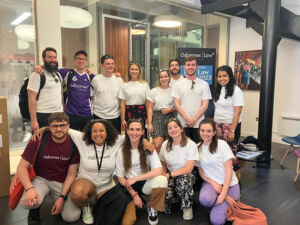
At Osbornes Law, we’re proud to be part of the Camden community. Supporting local charities, events and initiatives is central to who we are, both as a firm and as individuals. Our team regularly takes part in community projects, sponsorships and fundraising activities that make a difference locally.
Working together for a stronger community in Camden
- Partnership with NipNip Bike Workshop: We’ve partnered with NipNip to support sustainable travel and safe cycling across London. Find out more about our partnership with Nip Nip.
- Urban Hill Climb: As part of our ongoing support for cycling in North London, we’re proud sponsors of the Urban Hill Climb, an exciting annual race celebrating London’s cycling community. Find out more about our sponsorship of the 2025 Urban Hill Climb
- Queen’s Park Day & Book Festival: We’re pleased to support local arts and community events, including Queen’s Park Day and the Queen’s Park Book Festival
Charities we support
- The Winch: A Camden-based charity supporting local children, young people and families. Our team organises annual fundraisers, from sports days and bake-offs to pub quizzes, with proceeds going directly to The Winch’s community programmes.
- North London Hospice : Providing compassionate care for people with life-limiting illnesses. Osbornes Law has sponsored the Race the Neighbours 10K run in East Finchley and Muswell Hill on multiple occasions.
- London Legal Walk: Each year, our staff join fellow legal professionals to raise funds for legal advice charities across London and the South East.
What our clients say
★★★★★“I recently had the pleasure of working with Samantha Tayler Auld and her team at Osbornes Law, Camden Town, during the settlement of my late uncle’s estate. From the very beginning, I was impressed by their professionalism, compassion, and attention to detail. Navigating the complexities of estate settlement can be overwhelming, but Samantha made the process smooth and manageable.”
★★★★★“I have just bought a property in London with the help of Rachael Atkinson at Osbornes Law in Camden. I am very pleased with the service offered throughout the process. Rachael, assisted by Anna, was organised, thorough, good at planning ahead to avoid any last minute panic and most importantly very quick to reply to emails and phone calls. I was in very good hands!”
How to find us
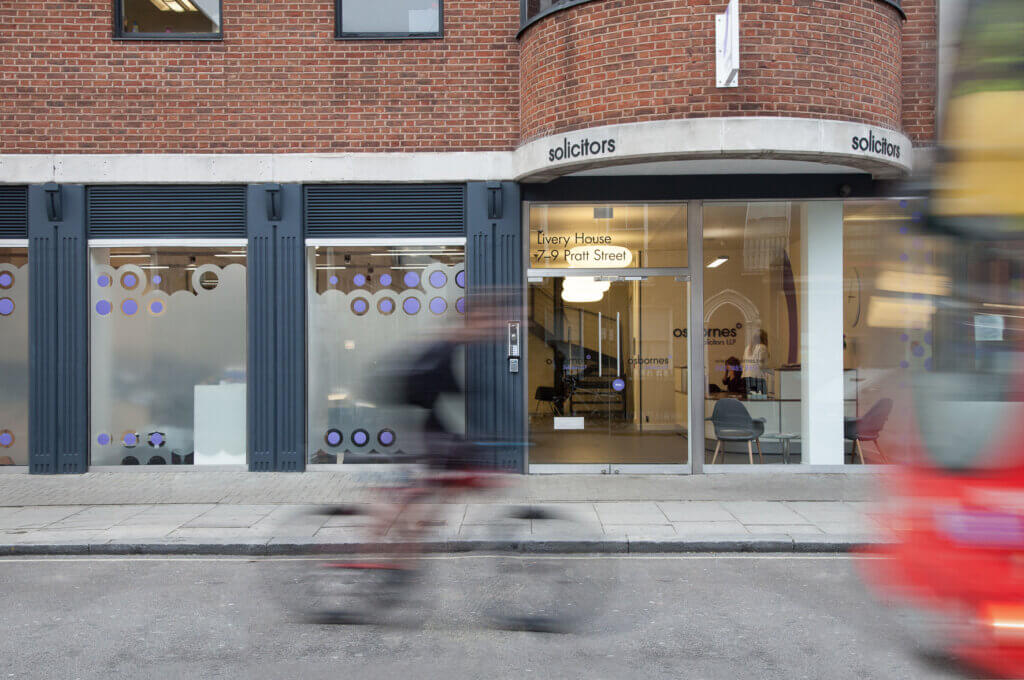
Livery House, 9 Pratt Street, London, NW1 0AE
Tel: 020 7485 8811
Fax: 020 7485 5660
Public Transport
From Camden Town Tube Station, Pratt Street is a 4 minute walk south on Camden High Street, and then left onto Pratt Street.
The nearest tube station is Camden Town on the northern line. Close by is Camden Road overground station, which is a 7 minute walk south-west on Camden Road towards Lyme Terrace, left onto Bayham Street, and then right onto Pratt Street.
Parking
The nearest parking is at 38-40 Pratt Street, NW1 0LY. From there, Osbornes Law office is a 2 minute walk south-west on Pratt Street.
Accessibility
The Camden Town office is fully accessible for wheelchair users.
See directions and accessibility
Public Transport
From Camden Town Tube Station, Pratt Street is a 4 minute walk south on Camden High Street, and then left onto Pratt Street.
The nearest tube station is Camden Town on the northern line. Close by is Camden Road overground station, which is a 7 minute walk south-west on Camden Road towards Lyme Terrace, left onto Bayham Street, and then right onto Pratt Street.
Parking
The nearest parking is at 38-40 Pratt Street, NW1 0LY. From there, Osbornes Law office is a 2 minute walk south-west on Pratt Street.
Accessibility
The Camden Town office is fully accessible for wheelchair users.
Related InsightsVIEW ALL
 13.4.2026
UK Maternity Taskforce and NHS Investment
Government Launches Taskforce and Investment in Maternity Care Following the publication of Baroness Amos’s Interim Report on Maternity and...
Read more 27.3.2026
“I Want to Be a Role Model, to...
Jo Wescott, Managing Partner at Osbornes Law, has been profiled by The Times following her appointment as the first woman...
Read more 8.3.2026
A different kind of International Women’s Day...
To mark International Women’s Day 2026, our Managing Partner, Joanne Wescott, speaks openly about leadership, the challenges of being one...
Read more- 28.11.2025
Autumn Budget 2025
The much-anticipated 2025 Budget delivered this week contains a number of notable changes due to affect individuals and businesses alike. It...
Read more  28.10.2025
Recognised Once Again Among the UK’s Leading...
We are proud to announce that our firm has once again been ranked by the UK’s most prestigious legal...
Read more- 7.10.2025
Court of Appeal: Domicile on Divorce is a...
Understanding domicile in international divorce cases The divorce team at Osbornes Law are experts in international divorce, with a reputation...
Read more - 6.10.2025
Osbornes Law Proud to Support the Oscar’s...
We were honoured to be the Headline Sponsor of the Oscar’s Wish Foundation’s 10th Anniversary Charity Ball on...
Read more - 9.9.2025
Osbornes Expands with New Family Law Partner
Osbornes continues expansion with key partner hire in family law We’re excited to continue our growth with the addition...
Read more  27.8.2025
Edward Taylor speaks to ITV News as the...
Government seeks to overturn High Court ruling on Epping asylum hotel case Osbornes Law featured in ITV News coverage earlier...
Read more 6.8.2025
Unclaimed Premium Bond Prizes: Katie de Swarte Speaks...
Our Head of Private Client Disputes Katie de Swarte, recently spoke to Channel 5 News about an issue affecting savers across...
Read more- 24.7.2025
Record Results for Osbornes in the Chambers HNW...
Osbornes Law celebrates continued success in Chambers High Net Worth 2025 We’re proud to announce that Osbornes Law has once...
Read more - 1.7.2025
Osbornes Law Announces Trio of Partner Promotions
Osbornes Law has added three new faces to its partnership as part of the London law firm’s latest round...
Read more  25.6.2025
Juntos por Valencia: London’s Solidarity Event
The Spanish community in London comes together in a solidarity event to support those affected by the DANA in Valencia...
Read more- 25.6.2025
Sam Collard speaks to BBC London on the...
In a recent interview with the BBC, Sam Collard, Partner at Osbornes Law, addressed a growing concern in the rise...
Read more - 11.6.2025
‘Worthless’ Shares Used to Undermine Divorce Claim
‘Worthless’ share transfer found to undermine wife’s financial claim The financial remedies team at Osbornes Law advise and represent...
Read more  12.5.2025
Estate Planning: New Tax Rules for DC Pensions
New changes to the taxation of DC Pensions will impact estate planning decisions In the Autumn Budget 2024, the Chancellor announced...
Read more 21.2.2025
Osbornes mourns the passing of Stephanie Prior
It is with great sadness that Osbornes Law announces the passing of our much-loved friend and colleague, Stephanie Prior. Stephanie...
Read more- 25.11.2024
Osbornes rated an Outstanding Place to Work by ‘...
Launched in 2001 Best Companies to Work For Lists and Best Companies Accreditation are now recognised as the standard in workplace...
Read more - 25.11.2024
Fertility in the workplace
Osbornes Law introduces new fertility testing benefit to empower 70% female staff to ‘take control of their reproductive health’ Osbornes Law...
Read more  25.11.2024
7th Consecutive ‘Times Best Law Firm’ Ranking for...
Osbornes Law Ranked in The Times Best Law Firm Guide for Seventh Consecutive Year Recognition and Ranking Osbornes Law has...
Read more 3.6.2024
Osbornes appoints its first female managing partner
Osbornes Law has appointed Joanne Wescott to be its next managing partner. She becomes the first female managing partner in...
Read more- 11.1.2024
New UK Supreme Court Ruling regarding Secondary Victims...
The Supreme Court has today, on the 11th January 2024, upheld the Court of Appeal’s order to dismiss the claims...
Read more - 21.4.2023
Success in Court of Appeal in child disability...
The Court of Appeal has today handed judgment in the case of Harrington v Secretary of State for Work and...
Read more - 17.1.2023
Court of Appeal Dismisses Legacy Benefits Claim
The Court of Appeal has today dismissed the legacy benefit Claimants’ appeal of the decision of the High Court dated 18...
Read more